Friday, 8 April 2022

Was D&D responsible for the explosion in popularity of RPGs in the 1970s?

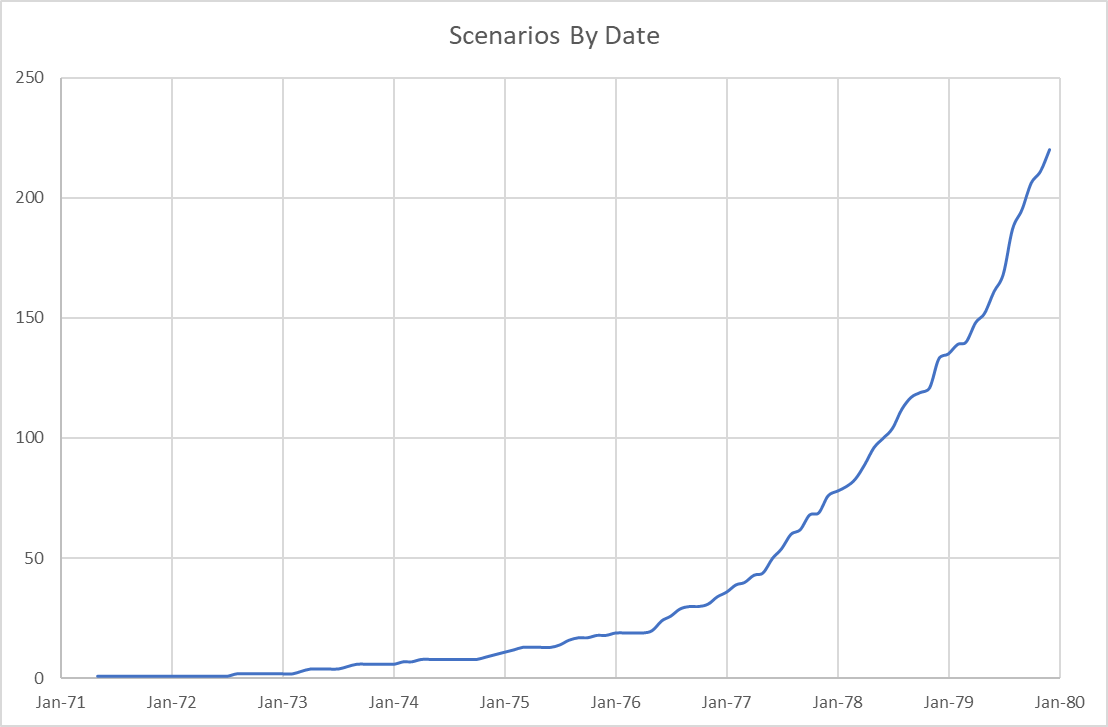
When I was researching the scenarios timeline I soon noticed that the number of scenarios was growing rapidly year on year. Because I found out the publication month for almost all the scenarios, we can clearly see this by plotting a cumulative graph of scenarios by date:

Because of this raw data we can dig into some fundamental questions about D&D without relying upon perceived wisdom or looking through the distorted lens of expectations. Looking closer at the data I realised that the near universal perception that RPGS are popular because of D&D is infact the wrong way round - RPGs would have become popular without the publication of D&D - instead the place of D&D would have been taken by something else which had been seeded from Blackmoor.

Saturday, 2 April 2022

Final Timeline of Early D&D Scenarios X: 1979 November-December

These last two dozen scenarios take us through to the end of '79 and the end of the run. So that's every scenario published in the 1970s - all two hundred of them (or rather, those that I've been able to uncover). The aim was to have a comprehensive reference list in chronological order so that I could investigate how they influenced each other, and to see how they developed - which is what this blog's going to focus on next.

The list is perhaps more defined by what it doesn't contain - anything that is clearly not D&D (such as Runequest), anything that is just a description of a setting (i.e. without actual gameable content). Other than that, the rule has been - if in doubt, include it. This has meant I've uncovered lots of items of interest and connections between them that I'd never have discovered with a narrower focus.

The published clause has been extended to include anything that was shared sufficiently that it became potentially influential. Thus I included the very first personal dungeons, and some unpublished tournament adventures which have survived - as both of these illustrate the history and development of scenarios very well.

It includes sample adventures, dungeon crawl boardgames, solitaire adventures, map-only products, key-only products, random dungeon creation tools. It contains adverts, cartoons, and colouring books. It includes famous modules published by major name publishers that have been revised and republished many times in many editions over the years, all the way down to school fanzines with a tiny circulation. It includes obscure scenarios that are unsung greats, and others that are best forgotten. I'm fairly confident when I proclaim that No-one owns an original copy of every published scenario in the list - though I'm pretty sure a couple of people come extremely close.

By Erol Otus, my favourite RPG artist, from The Howling Tower

Sunday, 27 March 2022

A Complete Timeline of Early D&D Scenarios IX: 1979 September-October

We're rounding the final corner now with this penultimate set of scenarios. This is an unusual set as it's two-thirds fanzines and one-third Judges Guild with just one other entry - a tournament that was published many years later by TSR. There are no small press publications, but this is no doubt because the small press items are very difficult to date, and there are several '79 scenarios which I have no month for so they are listed at the end of the year. 

This is the ninth installment of my series listing all of the D&D scenarios published in the 1970s. I hope by collecting them all in order it will allow developments, trends and influences to be identified- at the end I will write posts covering these various aspects. 

Since two-thirds of this selection of scenarios come from fanzines, here's another piece of Paul Blackwell's amazing fanzine art to put us in the mood (his work really deserves to be collected together and republished), this time from Demonsblood #4:

Saturday, 19 March 2022

A Complete Timeline of Early D&D Scenarios VIII: 1979 July-August

Since every year has double the number of scenarios compared to the previous year, progress through 1979 has slowed to a crawl. We've made it to the second half of '79 now, and two more posts after this should see us to the end. I say "we" as I could not have done it on my own - for this post I have to thank Andy Ravenscroft, Guy Fullerton, Jon Peterson, Allan Grohe, Bane McDeath, VivaVilez, and Ian (mbassoc2003) for providing photos/details of many of these scenarios, and also Andy Ravenscroft for his comments which provide a perspective on the 70's zine scene from one of its contributors.

This is the eight installment of my series covering all of the D&D scenarios published in the 1970s. The aim is to identify developments, trends and influences - at the end I will write posts covering these various aspects. 

So gird your loins and prepare for battle as we face two dozen more scenarios - including four of the most famous scenarios of all time, all released on the very same day...
(Paul Blackwell is the artist, from Trollcrusher #18)

Saturday, 12 March 2022

A Complete Timeline of Early D&D Scenarios VII: 1979 May-June

Moving further into 1979, there are 13 scenarios for the months of May and June alone - about the same as were published in the whole of 1976! (The list may well increase - indeed since last post I've added an extra entry for 1978 Jan-June for The Tomb of Lord Advandey from The Grimoire #1 as I'd forgotten it was in issue 1 which was '78). Surprisingly, half of the entries are either Tournament, Competition, or Solitaire adventures.

A much higher standard of scenario is now the norm, and this selection contains a scenario which still consistently rates highly in "best modules of all time" lists, but also at the same time it contains one that set in motion a dangerous trend in scenario design.

One final word of warning to any prospective adventurers - before you attempt to take on any of these scenarios, make sure you're as well prepared as this party in Demonsblood #2, as illustrated by the ever-fantastic Paul Blackwell:

Friday, 4 March 2022

A Complete Timeline of Early D&D Scenarios VI: 1979 Jan-April

We're in 1979 so it should be the final stretch now.. except that 40% of all scenarios published in the 70s were published in the last year!

The fact that there is now a "second generation" of more mature scenarios is nicely illustrated by Paul Blackwell's lighthearted dig at "old fashioned" scenarios of yesteryear which appeared in Trollcrusher #16 (in the middle of the scenario Quivia):
The revolution had not entirely swept away the old guard overnight, and one or two stragglers remain, as we shall see.

Saturday, 26 February 2022

A Complete Timeline of Early D&D Scenarios V: 1978 July-Dec

In this (attempt at a) Complete Timeline of early D&D scenarios, we have now reached the second half of 1978, and with the continued explosion of popularity we have 30 entries for this later half of the year alone.

We've seen how the style has gradually developed over these few years, with Judges Guild, The Dungeoneer, and then British Fanzines taking it in turns to increase the sophistication and push up the standard - but there is about to be a major seismic shift in adventure design with the publication of a series of six modules by a company making a rather late entry into the competition.

If you've been following this series, you might be interested to know I've updated the earlier entries to include a few more scenarios I've uncovered so if you look back through the pictures you might spot one or two new and interesting items, in particular several Minneapolis entries in 1971-1975.

Name: Steading of the Hill Giant Chief
Date: 1978.7
Author: Gary Gygax
Publisher: TSR (G1)
Type:  Tournament (Origins IV)
Notes on Date: See tournament date link earlier. These are reviewed in WD #9, and advertised The Dragon #19 - EDIT but are "new" in JGJ S July '78 so it does look like these were available at Origins and they are the tourney modules to be available at the TSR booth advertised in The Dragon #14 & #15.
Notes: It is difficult to overstate how much G1 and its five brethren changed D&D. Up until this point there was an expectation of a megadungeon central to every campaign - published adventures were usually either a small stand-alone add-on (often a tomb), for a tournament (generally linear, also often a tomb), or an alternative dungeon of several levels. Although G1 was written for a tournament, it is not linear, and the main influence from it being a tournament is that Gygax has written up the rooms in a careful detailed fashion so that all DMs can offer the same experience. In a similar fashion to previous tournament dungeons each round is linked to the last, but in this case across two tournaments Gygax creates six linked modules, with a connected plot (however slight). A lot of scenarios at this time had humorous elements, which clearly irked Gygax (see below for his views on The Cliffs of Mentadorra 1978.8) and these modules all strongly eschew that frivolous/gonzo aspect - in G1 instead you'll find a dangerous Temple to a dark God hidden behind a rockfall. The whole place is described with details that encourage interesting play "Under the furs on the bed is a sleeping giantess who will awaken on a 1 in 4 if a loud noise occurs in the room", "There is no treasure, but by wearing the young giants garb, with suitable padding, the party could pass as the youngsters if not seen closer than 20'". The underground level has an ongoing standoff between the escaped orc slaves and the bugbears - how many parties did like my players and set them fighting each other?
From another angle, the production values of G1 far outstrip any standalone adventure that's gone before. Ironically the iconic blue maps were much criticised in reviews of the time for being unreadable, but it's not just nostalgia for those detachable cardboard covers - when you saw it in the store and knew there would be a map just on the other made them mysterious and enticing.