Sunday, 17 July 2022

Original Scenarios Resurrected III: The Temple of Psaan (1980, Andrew Ravenscroft)

Welcome to the third entry in the series Original Scenarios Resurrected, wherein D&D scenarios from the 70s and early 80s are republished with the permission of the authors, usually together with extra contemporaneous material. Today we look to The Temple of Psaan by Andrew Ravenscroft. For parts I and II see here and here.

Today we move on to The Temple of Psaan by Andy Ravenscroft, originally published January 1980 in The Beholder issue 11. Andy started out writing for Shire Talk, a small print run local D&D fanzine, but he soon moved onto more mainstream D&D fanzines, where his contributions were often illustrated by his friend Quentin Manley. Andy stopped writing for role playing games in the mid 80s, but more recently he is the author and publisher of Dark Streets, a science fiction noir set in near-future London. He is well known to regular readers of this blog for his contributions to the Complete History of Early D&D Scenarios, providing much of the info on scenarios in fanzines.

Andy published three D&D scenarios in this period, the second of which is the focus of today's post - Temple of Psaan. Originally titled The Temple of Psaan, it lost the "The" when it was published for reasons unknown. It is a short scenario inspired by the introductory chapters of L. Sprague de Camp's novel "The Fallible Fiend", a story about a demon servant whose literal mindedness causes him to fail one master after another.

Fanzine submissions were not usually returned to the author, so Andy no longer owns copies of the originals. In the case of Demonsblood, which was more akin to an APA, the articles were included exactly as typed. For The Beholder, however, Guy Duke retyped submissions. It is quite unusual, therefore, that Andy retains the original manuscript for The Temple of Psaan, which we present here for the first time, along with the published version of the adventure.

You will notice that the scan of the published scenario includes pencil marks where the original owner recorded hit points lost during combat. I've not removed these as they're a nice touch as they show that published adventure were played, not just read

It is immediately obvious that the printed scenario is far more developed than the handwritten original, and the most likely explanation for its surival is that the published version derives from a revised version Andy prepared for publication. In particular, many details in the original are explained in the published version.

As two simple examples, in the original there are 5 war-dogs in a room by the entrance - in the published version it details "Maldivius' guard dogs - he keeps 5 dogs in here to deter intruders. Attack without fear; no subdual." In the original for Andy's eyes only this was unnecessary detail, but it is needed for the published version to make it clear for others. Similarly in one room it simply states a Gnoll has for treasure 1GP, and for the published version this becomes "He is in possession of the princely sum of 1GP" which makes it clear that the treasure isn't just pathetic, it's intentionally humorously pathetic.

These details are what make the existence of the manuscript interesting - we can see here how a dungeon for personal use gets altered into one intended for publication and use by others. We cannot infer from the terse 1-line descriptions of early scenarios whether it was just a monster in a room to be killed, or if the DM was to improvise the detail, and how much information was in the DM's head who didn't see any need to write it down for themselves.


For my own scenarios I favour an extremely terse style where all the info is noted on the map in the blank spaces with lots of arrows. This is a style I developed in the mid 80s and it means I can not only see information at a glance, it's easy to ammend as you develop. There is never a formal key, and I hate to think what others would make of my (often rather illegible) scrawl!

Finally here's a short Bibliography of Andy's work.

Bibiliography

July '79 - Demonsblood # 3: The Raven Croaks 1 (inc. falling damge rules)

Sept '79 - Demonsblood # 4: The Raven Croaks 2 (inc. Clearwater Caverns, a D&D scenario)

Nov '79 - Demonsblood # 5: The Raven Croaks 3 (inc. background skills)

Dec '79 - The Beholder #10: The Archer (a new character class) & a D&D crossword

Jan '80 - Demonsblood # 6: Reviews

Jan '80 - The Beholder #11: (The) Temple of Psaan

Mar '80 - Demonsblood # 7: The Raven Croaks 4 (inc. poisons & Cerberus Class scoutship for Traveller)

July '80 - The Beholder #16: The Devil's Quagmire - co-authored with Quentin Manley. A 14-page scenario

2014 - Dark Streets, a science fiction noir set in near-future London

Also contributed to Shire Talk, a local fanzine.

Thanks to Andy Ravenscroft for allowing me to publish this, and also to Guy Fullerton for his help.

Sunday, 26 June 2022

Original Scenarios Resurrected II: The Complete Barbarian (1977-79, Brian K. Asbury)

Welcome to the second in the series Original Scenarios Resurrected, wherein D&D scenarios from the 70s are republished with the permission of the authors, usually together with extra contemporaneous material. Today we look to The Barbarian by Brian K. Asbury. For part I see here.

Brian K. Asbury was a prolific writer in the early days of the UK D&D scene. He wrote numerous articles for White Dwarf and other early fanzines and magazines. He devised the Xill (from the Fiend Folio) but is probably best known as the author of "The Asbury System" for awarding XP based upon succesfully using thief skills or casting spells etc (from White Dwarf #5-9) and  - the focus of today's post - the first Barbarian character class.

The Barbarian, which appeared in White Dwarf issue 4 December 1977, was written for OD&D. It was many years before the "official" AD&D Barbarian was published, and Brian's class was very popular (being reprinted in The Best of White Dwarf Articles Volume 1, and even translated into Italian as part  of "The Blue Book"). It is a very atmospheric class, with great abilities including Fearlessness (Fear instead makes them go beserk) and Sensing Danger, whereas the Unearthed Arcana version is rather bland.

But furthermore Brian's Barbarian also had something which the official AD&D version never had - it's own dedicated scenario.

Tuesday, 21 June 2022

Original Scenarios Resurrected I: The Solo Dungeon (1977, Richard Bartle)

Welcome to a new series where out of print D&D scenarios from the 70s are resurrected (and often expanded with contemporary material by the original author). These Original Scenarios are resurrected as opposed to being reincarnated, since (as everyone knows) in D&D when you're reincarnated you have only a slim chance of coming back in the same form and are of a lower level - an OD&D adventure would be in danger of being reincarnated as a 5th edition adventure...

To start with, we present The Solo Dungeon by Richard Bartle from 1977, wherein you can get a truly authentic 1970s dungeon crawling experince. Richard wrote this adventure shortly before he co-created the world's first MUD - MUD1 - in 1978. Along with a scan of the adventure, we present a scan of the original manuscript along with the original introduction. 

Copies of this do come up on ebay from time to time, but not often, and they're not cheap. Last Saturday a copy sold for rather a tidy sum:

That's a health rate of return on your investment. I wonder how much the original '77 version would fetch?

Sunday, 12 June 2022

1975.7: The Inner Temple of the Golden Skeleton (Ian Livingstone)

Today's dungeon was never published at the time, nor did it have a widespread audience, so that means it doesn't truly belong in my list - but it does deserve highlighting for it is pivotal in the history of D&D. Thanks go to Kelvin Green for drawing my attention to it! The Inner Temple of the Golden Skeleton is a dungeon from 1975 by Sir Ian Livingstone. At this point no dungeons had ever been published (only sample extracts) - so the blue colouring is just a co-incidence - and the map+key was only written for Ian's own usage (so don't read too much into the lack of detail or roughly drawn map). It's importance is that it was one of the very first dungeons developed outside of the USA, with very little opportunity for it to be influenced by American dungeons, and it has a distinctly different feel to its state-side contemparies, though much about it remains a mystery:

Friday, 8 April 2022

Was D&D responsible for the explosion in popularity of RPGs in the 1970s?

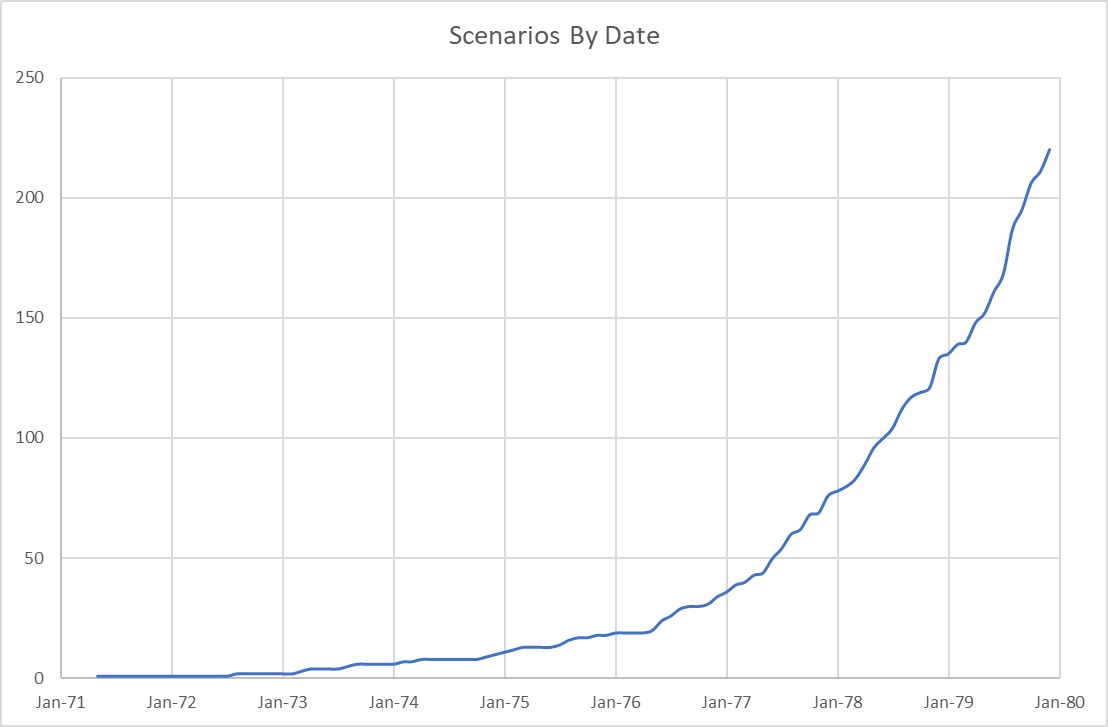
When I was researching the scenarios timeline I soon noticed that the number of scenarios was growing rapidly year on year. Because I found out the publication month for almost all the scenarios, we can clearly see this by plotting a cumulative graph of scenarios by date:

Because of this raw data we can dig into some fundamental questions about D&D without relying upon perceived wisdom or looking through the distorted lens of expectations. Looking closer at the data I realised that the near universal perception that RPGS are popular because of D&D is infact the wrong way round - RPGs would have become popular without the publication of D&D - instead the place of D&D would have been taken by something else which had been seeded from Blackmoor.

Saturday, 2 April 2022

Final Timeline of Early D&D Scenarios X: 1979 November-December

These last two dozen scenarios take us through to the end of '79 and the end of the run. So that's every scenario published in the 1970s - all two hundred of them (or rather, those that I've been able to uncover). The aim was to have a comprehensive reference list in chronological order so that I could investigate how they influenced each other, and to see how they developed - which is what this blog's going to focus on next.

The list is perhaps more defined by what it doesn't contain - anything that is clearly not D&D (such as Runequest), anything that is just a description of a setting (i.e. without actual gameable content). Other than that, the rule has been - if in doubt, include it. This has meant I've uncovered lots of items of interest and connections between them that I'd never have discovered with a narrower focus.

The published clause has been extended to include anything that was shared sufficiently that it became potentially influential. Thus I included the very first personal dungeons, and some unpublished tournament adventures which have survived - as both of these illustrate the history and development of scenarios very well.

It includes sample adventures, dungeon crawl boardgames, solitaire adventures, map-only products, key-only products, random dungeon creation tools. It contains adverts, cartoons, and colouring books. It includes famous modules published by major name publishers that have been revised and republished many times in many editions over the years, all the way down to school fanzines with a tiny circulation. It includes obscure scenarios that are unsung greats, and others that are best forgotten. I'm fairly confident when I proclaim that No-one owns an original copy of every published scenario in the list - though I'm pretty sure a couple of people come extremely close.

By Erol Otus, my favourite RPG artist, from The Howling Tower

Sunday, 27 March 2022

A Complete Timeline of Early D&D Scenarios IX: 1979 September-October

We're rounding the final corner now with this penultimate set of scenarios. This is an unusual set as it's two-thirds fanzines and one-third Judges Guild with just one other entry - a tournament that was published many years later by TSR. There are no small press publications, but this is no doubt because the small press items are very difficult to date, and there are several '79 scenarios which I have no month for so they are listed at the end of the year. 

This is the ninth installment of my series listing all of the D&D scenarios published in the 1970s. I hope by collecting them all in order it will allow developments, trends and influences to be identified- at the end I will write posts covering these various aspects. 

Since two-thirds of this selection of scenarios come from fanzines, here's another piece of Paul Blackwell's amazing fanzine art to put us in the mood (his work really deserves to be collected together and republished), this time from Demonsblood #4: