I've seen several people commenting recently that when they reread the rules of AD&D they discovered they were doing it wrong. This may be so, but not quite of the same order of magnitude as the makers of the Dungeons & Dragons cartoon. What a fantastic opportunity this was to introduce the game to a whole new audience. After watching a few episodes of this series, new players would flock to the game, eager to join in with the latest craze...
So, let me see if I understand this correctly - you play Dungeon Master and tell us what to do, in riddles.
What do you mean my Cavalier needs a horse? You're wrong – I've seen the show and he ain't got no horse. Do you know nothing? What makes them different from Fighters isn’t having a horse – what makes them different is not having a sword as they abhor violence.
I want to play an Acrobat. Fifth level? I need to wait until I’m fifth level???
Can I have a baby unicorn as a pet? I think they're so cute, the way they bleat like a sheep. So what if I'm male?
I need a hat. Why? Duh – so I can cast spells.
So what magic items do I start with? What do you mean I don't get any???
Orcs? I can deal with them. I scream at them and in their confusion we run through the middle of them.
Perhaps it's a magic cloak – I put it on and try taking the hood on and off a few times to see what happens.
We've had retroclones of every other version of D&D – surely now the time is ripe for a retroclone of "AD&D – TV edition". I warn anyone brave enough to take on this challenge that it'd take a lot of work - it'd mean an almost complete rewrite of OSRIC.
Showing posts with label Best & Worst. Show all posts
Showing posts with label Best & Worst. Show all posts
Monday, 7 September 2015

Saturday, 5 September 2015
The Best: Wainwright's Pictorial Guide
Continuing my irregular series on the Best and Worst things I've ever seen in RPG products, it's time for another "Best" post (despite the fact that the "Worst" posts get twice as many hits!).
This time I move from an actual RPG product to one that should be an RPG product. One that every RPG product should aspire to be like. One that is a work of art to behold, is of eminent practicality both for planning adventures and when you're having them, and is inspirational when you just pick it up to read it. I am, of course, talking about the Pictorial Guide to the Lakeland Fells, written by


It threw typographical conventions to the wind, and is entirely written in pen and ink. This enables AW to freely mix text and maps and illustrations. Each ascent route is given a dedicated page, which the author describes as
"The routes of ascent…are depicted by diagrams that do not pretend to strict accuracy: they are neither plans nor elevations; in fact, there is deliberate distortion in order to show detail clearly: usually they are represented as viewed from imaginary ‘space-stations'."The resultant map-come-route descriptions are incredibly easy to use in practice. There's no back and forth between the map and the route description; everything you need is to hand where you need it.

What particularly appealed to me was that you could climb one hill using one route (often with variations), then link together summits with the ridge routes, descending back to the start; thus discovering your own route. Definitely no rail-roading here!

All my childhood holidays were spent in the hills, most of them in the Lake District, and those mostly "climbing the Wainwrights". When I met starting dating my wife in 1990 we set about climbing them all together, which took us until 1996 (we had no car and were living in the south of England so it took a while). When we married in 1994 we did his "Coast to Coast Walk" as our honeymoon. We still have the bug - we spent the week before last in a cottage in Eskdale with my parents and our three children, still finding new routes to try and hidden spaces to discover.
If only every RPG product was as great to look at, inspirational to read, easy to prep, and easy to use in play as this.
Thursday, 16 July 2015
The Worst:Trollstone Caverns

My First RPG
My first RPG was Tunnels & Trolls (Fifth Edition) in 1982. We only played it a few times before moving to Dungeons & Dragons, but I always retained a soft spot for T&T, especially Liz Danforth's fantastic art.
I knew it was more famous for solo play than for groups with a DM, but I have always assumed this was due to a distaste for the combined combat outcome - that is, whichever side wins each round takes no damage, the other side all take damage (lessened by armour).
The combat system, in brief, is: everyone makes a combat roll, you take the total for both sides, the losing side takes the difference as damage (distributed evenly) but reducing this by each target's armour.
The Kobayashi Maru
A couple of years back my son wanted to try his hand at DMing so I suggested T&T, and he ran us through the introductory adventure Trollstone Caverns. In the very first combat, which is apparently unavoidable and is evidently to introduce you to how combat works, we had to run away before we were all killed - and it appeared almost impossible for us to win the battle, in fact it appeared nearly impossible to even wound our assailants.
I thought my son must have got something wrong about the adventure, so later I looked at the encounter. You get one monster per PC in a one-on-one combat, of a random type. For example, the weakest monster has MR 16 which means it gets 2d6 + 8, the strongest is MR 24 with 7 armour which means it gets 3d6 + 12. If I tell you that the sample character included in the rulebook, Fang the Delectable, has 3d6 - 1 for combat, you can see he's in trouble against even the weakest of the possible monsters: he averages a combat roll of 9.5, while the weakest monster averages 15, even with 6 armour he's taking damage half the rounds, and is exceedingly unlikely ever to score a hit. Against the other monsters he's dead without a chance. And one monster is immune to non-magical attacks.
I just ran four sample combats of Fang against the weakest monster, and he died four times in succession (I would have run more, but they went on for ages). He only did 3 points of damage in total over all four battles. So the sample character in the rulebook is almost guaranteed to die in the first combat.
Now our characters (digging out the character sheets and the session notes) had:
- Viper (Rogue): 4d6+7, 8 CON, 8 armour
- Hawk (Warrior): 3d6+3, 6 CON, 24 armour
- Flash (Wizard): 2d6 -1, 7 CON, 8 armour
So, the introductory adventure for new players to RPGs includes an unavoidable first combat, which has a high likelihood of being unwinnable!
(Evidently, like Kirk, we should have stolen the module the night before, and altered it to guarantee victory).
Digging Deeper
I initially put this down to a horrific lapse in playtesting this adventure, but this got me thinking about the combat system, so I ran a computer simulation. What I discovered was that given a particular character’s dice and adds there is a very narrow range of MRs between those monsters which stand almost zero chance of winning and those against which you stand almost zero chance of winning.
I ran a sample combat, and found that below an MR of 19 the monsters had less than a 1% chance of winning against my PC, and above an MR of 24 my PC had less than a 1% of winning.
If you have group combats against multiple monsters, combining the results from both sides decreases the chance of a freak result - the outcome of the combats become more and more certain.
For example, I ran five PCs versus one monster, and found that the below an MR of 110 the monster had less than a 1% chance of winning, and above an MR of 118 the PCs had less than a 1% chance of winning.In addition, the average length of a combat went from a well balanced match giving an average of 9 rounds with one PC, to an average of 70 (!!) rounds with five PCs. Note that this is with minimal armour (5) - extra armour makes the combats yet longer: with 5 PCs and 10 armour it goes up to 1900 rounds. I think we call that a stalemate.
So with a party of characters, almost every combat is a fait accompli, and the few that aren't go on so long they're effectively a stalemate. I can't believe this system was ever played with parties of PCs as written.

A Saving Grace?
Any reference to T&T combat talks about the importance of Saving Throws in combat, but in Fifth edition this is only mentioned in the section on "Unusual Combat Situations", and the only example is a simple "I can't win this fight, so I try a daring do-or-die manoeuvre." If this fails you take all the monsters hits as damage (so you're likely dead), if you succeed then the monster takes all hits as damage (and if not dead, its MR is so reduced that you'll win). This is a "last throw of the dice" final desperate tactic - not an expected feature of combats.
Calling All Stations!
So has anyone actually any experience of a long running T&T multi-player campaign with the rules as written?
Is it really only suitable for solo play?
Do the combat manoeuvres and "spite damage" in later editions fix things?
Or is the excitement over the Deluxe Edition Kickstarter purely about nostalgia and love for Liz Danforth's fantastic art?
If you love the game and think I'm being truly mean, redress the balance and show me how I'm doing it wrong. Until then, I'll just look at the art.
Monday, 13 July 2015
The Best: Hand Drawn Maps
Whilst thinking about Geomorphs I was reminded that Dyson mentioned that his style was reminiscent of Chaosium's hand drawn maps in early Runequest modules.
Now I haven't seen much of the old Chaosium products so I can't comment on their maps, but for me, hand drawn maps remind me of adventures in fanzines, such as this one featuring cross-hatching from Demons Drawl #9 Dec 1984:...why make the maps pretty?Because it adds to the GM immersion into the game. Gaming is about roleplaying, and anything that gets you further into the mood and setting is a major boon. So old-school styled maps like the ones I draw remind me of the old Chaosium products that I loved when I was a young one in the hobby - and thus they get me in the mood for that style of game again, thus helping me run such a game.

Lawrence Beckett has done a very nice drawing of the abbey with matching floorplans. Seeing this again triggered a memory of the old Pelinore maps from Imagine Magazine - these by "Kh" from August 84 look like the inspiration for Lawrence:

Side elevations, floorplans, and cross hatching. I particularly appreciate the locations named on the map in lieu of a key.

For evocative hand drawn dungeons I was always drawn to the dungeon levels in City State of the Invincible Overlord. I liked the odd shapes and the odd noises - laughter, moaning, growling...

My own early efforts at the time were sadly a little lacking... but this effort from 1983 (when I was 11) is interesting to me as it's a one-and-a-half-page dungeon (the other half page is on the back):

Don't ask me why I used pink paper! Notice the key fact - there is no key. My earlier efforts had a keyed map, by this time I'd already realised it was better to put the details on the map. In fact many of my old TSR modules have pencil marks on the maps where I'd written directly on the map what was in each rooms.
I see many attempts by people to produce "professional" looking maps using computers, and I look at these hand drawn maps, and I prefer them in every way. It's not just nostalgia - they're evocative, unbounded and free. When you draw free hand you are limited only by your imagination – notes, illustrations, side-elevations, isomorphic, multi-levelled. Anything that occurs to you can be added.
As an aside, my Geomorph investigations also stumbled across "Pythagorean Tiling" which can be used to tessellate 10x10 Geomorphs and 15x15 Geomorphs into a pattern which obscures the joins between tiles by staggering them:

This looks quite appealing, and stops your dungeon from being rectangular. I'm still considering the pros and cons of having edge pieces (which this pattern makes more difficult) or removing any passages which go off the map.
Sunday, 14 June 2015
The Best: The Tomb of Aethering The Damned
 Back in 1982/83 I purchased a whole load of Judges Guild modules, mostly (I think) for the maps (as they are often very evocative). Sadly a couple of them were - how shall I put it - sadly lacking (The Dragon Crown in particular).
One of the ones that most definitely wasn't lacking was "The Book of Treasure Maps" by Paul Jaquays. It gives five small modules, each with some sort of treasure map, ready to be dropped into an ongoing campaign.
I never ran any of them at the time, and then I moved into my MERP / Rolemaster phase, so it was twenty five (!!) years before I ran a game of D&D again. When they found a treasure map, it obviously had to be one from this old book...
Map of the Tombe Of Aethering Who Is Called Damned
 Now this map has a couple of fantastic bits - the name, the "hidden entrance", the question marks for unknown areas, the fact that you have a map to the treasure but only a vague idea of the location, and the evocative "copyed from the original" and a clue that the tomb "is not yet finished" so the map is missing something.
The module gives you rumours about Aethering's Tomb which can be discovered from local NPCs or libraries, so there was plenty of fun with musty unhelpful librarians and useless extra pieces of information I invented for them. For example, if the library had no information I'd tell them instead that they found a tome on Tomb construction with valuable hints such as "always use the best quality stone" and "never trust contractors".
Finding the tomb entrance isn't easy - it has been hidden behind a river redirected to form a waterfall over the entrance - my players discovered the dry bed of the old river and investigating that lead to the waterfall and the narrow path leading behind.
The tomb contains several varied traps, the tombs of his Wife (tries to possess a PC) and Son (a mummy nailed to the wall hand and feet) both of which are my sort of disturbing, the passages have been further excavated so the secret door isn't where you expect, there's a false tomb, and the real tomb which can be found if you maintain belief that the map is correct and hence deduce a corridor has been blocked off with a secret door. Even then, you have to persevere to find the buried treasure.
I think the imagery in this module has heavily influenced me - last night the players had to rescue some prisoners so I had them suspended in cages above a pool of piranhas - it's not just a random bunch of undead, it's undead who all hated each other in life and want revenge in death. Don't you love families?
The adventure is great throughout - in particular I love the author's illustration of the mummy nailed to the wall:

Yes, that's a cursed amulet hanging round it's neck! The only changes I made in play were to beef up the monsters a little, and to turn the cursed skull with the gem inside into a skull with gems for eyes that when touched turned into an "Eyes of Fear and Flame" from the Fiend Folio.
The tomb is only 8 pages of the 52 page module - the other adventures also look good, but I've never actually DM'ed them - yet!
Thursday, 23 April 2015
The Worst: Thieves turned up to 11
And now for something completely different.
This is the fourth in my series of the Best & Worst bits that I have had the luck (or misfortune) to read in RPG products. Normal service will resume shortly...
In 1981 David Cook and Steve Marsh's Expert D&D rule book was published.
The highest level covered is 14th, and at 14th level Thieves have 99% success in all skills except Pick Pockets which is 125% and Hear Noise which is 1-5. Awesome.
What can the future bring for 15th level+ in the forthcoming Companion Set?
Thieves will therefore gain new abilities requiring greater skill and danger. These will include the ability to climb overhangs, upside down, ventriloquism, powers of distraction, and the ability to mimic voices.
Cool...
Roll on 3 years and Frank Metzner's Companion Set finally arrives. Flick through the book to find these promised gems...
This is the fourth in my series of the Best & Worst bits that I have had the luck (or misfortune) to read in RPG products. Normal service will resume shortly...
In 1981 David Cook and Steve Marsh's Expert D&D rule book was published.
The highest level covered is 14th, and at 14th level Thieves have 99% success in all skills except Pick Pockets which is 125% and Hear Noise which is 1-5. Awesome.
What can the future bring for 15th level+ in the forthcoming Companion Set?
Thieves will therefore gain new abilities requiring greater skill and danger. These will include the ability to climb overhangs, upside down, ventriloquism, powers of distraction, and the ability to mimic voices.
Cool...
Roll on 3 years and Frank Metzner's Companion Set finally arrives. Flick through the book to find these promised gems...
Level
|
Open Locks
|
Find Traps
|
Remove Traps
|
Pick Pockets
|
Move Silently
|
Climb Walls
|
Hide in Shadows
|
Hear Noise
|
15
|
75
|
73
|
67
|
90
|
70
|
101
|
58
|
87
|
From 99% down to 58%??? What the £&*$? This is the epitomy of lame.
Unbelievably even at 25th level you aren't back up to your former status - in fact you need to wait until the Master rules come out and you rise to level 36 (!!!) before you get better than you used to be in all skills than you used to be at 14th level.
That's right: the game extends the game from 14 levels to 36 levels by... making 36th level the new 14th level.
Nigel Tufnel: The numbers all go to eleven. Look, right across the board, eleven, eleven, eleven and...
Marty DiBergi: Oh, I see. And most amps go up to ten?
Nigel Tufnel: Exactly.
Marty DiBergi: Does that mean it's louder? Is it any louder?
Nigel Tufnel: Well, it's one louder, isn't it? It's not ten. You see, most blokes, you know, will be playing at ten. You're on ten here, all the way up, all the way up, all the way up, you're on ten on your guitar. Where can you go from there? Where?
Marty DiBergi: I don't know.
Nigel Tufnel: Nowhere. Exactly. What we do is, if we need that extra push over the cliff, you know what we do?
Marty DiBergi: Put it up to eleven.
Nigel Tufnel: Eleven. Exactly. One louder.
Marty DiBergi: Why don't you just make ten louder and make ten be the top number and make that a little louder?
Nigel Tufnel: [pause] These go to eleven.
In the long history of nerfing, this nerfing of the Thief has to be the nerf to end all nerfs. And the saddest thing? The thief was always the worst character class in the first place.
Tuesday, 31 March 2015
The Best: The Maps of Pete Fenlon
Over the years there have been many fantastic maps in RPGs, many have captured my imagination, but none to the extent that Peter Fenlon's maps for MERP did.

These maps induced in me a longing to climb those ranges of mountains, explore the strange towers atop hills, and follow the dotted trails. Features always went beyond the edges of the maps, inviting you to look beyond. Over many years I collected more and more of the maps, always looking to get a complete set, so when ICE lost the Middle Earth licence and there had never been a full-size version of the map of Lindon I was dismayed.
I still wished for a map that joined them all together, but it looked like a lot of work, then a couple of years ago this collage map below appeared on the internet from zikull (whoever he is). A fantastic job!

(It looked like he had a map for the missing north west corner, but sadly on closer inspection it's just a cut and paste of another bit of the map.)
When I played MERP these maps were always something that I loved, but my players rarely saw. With hex maps I knew how to let the players do their mapping, but with these grid-less maps I was at a loss. Now I play with grid-less maps and trace out the features as required, e.g. start with major features such as cities, then fill in the rest as they're discovered. If my own maps ever achieved this level of greatness I could thus share them with my players.
Which leads me to the Campaign Cartographer's Pete Fenlon style. Here is an example map drawn by modric:

(Taken from http://rpgmaps.profantasy.com/?p=1948 )
Now I'm not keen on using computers for drawing dungeons and the like - it seems like 100 times as much work for not enough gain unless you're selling it - but if you have a wilderness map that's part of a long running campaign I can certainly see the attraction.
Feel free to comment about any maps you're inspired by!
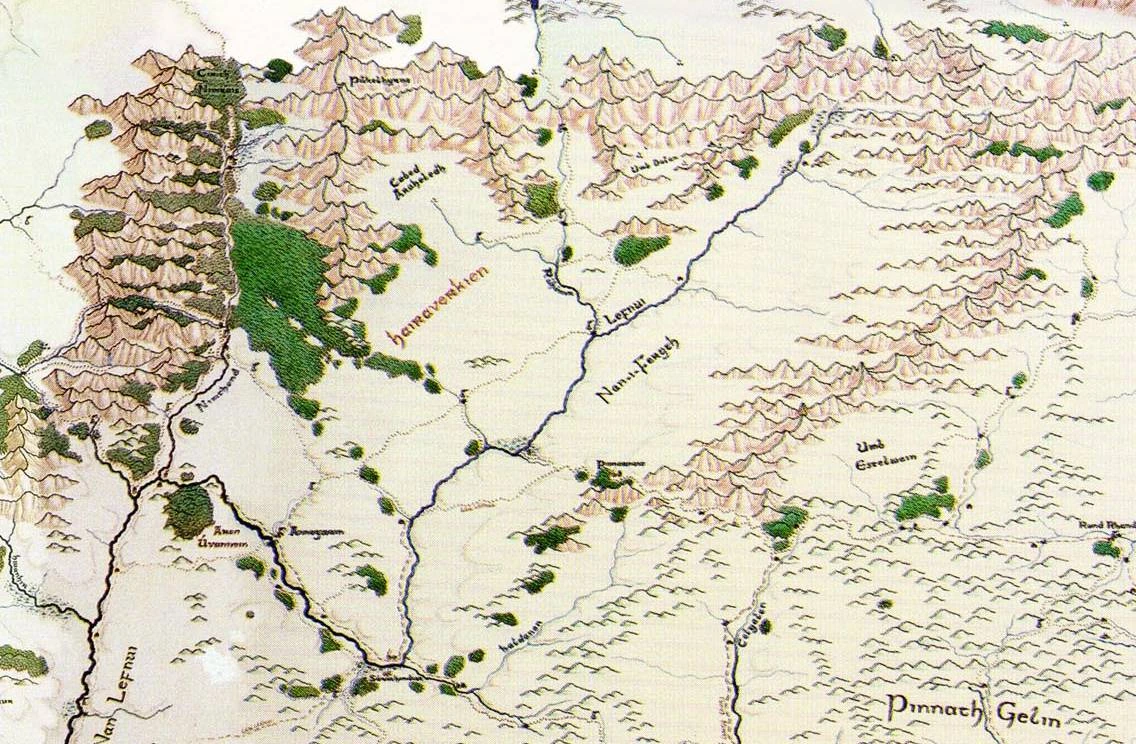
These maps induced in me a longing to climb those ranges of mountains, explore the strange towers atop hills, and follow the dotted trails. Features always went beyond the edges of the maps, inviting you to look beyond. Over many years I collected more and more of the maps, always looking to get a complete set, so when ICE lost the Middle Earth licence and there had never been a full-size version of the map of Lindon I was dismayed.
I still wished for a map that joined them all together, but it looked like a lot of work, then a couple of years ago this collage map below appeared on the internet from zikull (whoever he is). A fantastic job!
(It looked like he had a map for the missing north west corner, but sadly on closer inspection it's just a cut and paste of another bit of the map.)
When I played MERP these maps were always something that I loved, but my players rarely saw. With hex maps I knew how to let the players do their mapping, but with these grid-less maps I was at a loss. Now I play with grid-less maps and trace out the features as required, e.g. start with major features such as cities, then fill in the rest as they're discovered. If my own maps ever achieved this level of greatness I could thus share them with my players.
Which leads me to the Campaign Cartographer's Pete Fenlon style. Here is an example map drawn by modric:
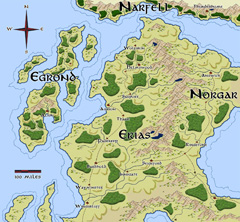
Now I'm not keen on using computers for drawing dungeons and the like - it seems like 100 times as much work for not enough gain unless you're selling it - but if you have a wilderness map that's part of a long running campaign I can certainly see the attraction.
Feel free to comment about any maps you're inspired by!
Wednesday, 25 March 2015
The Worst: Horses, Chickens and Donkeys
"Portals of Irontooth" by Rudy Kraft, 1981:
11 Stable: The animals in the stable include Horses, Chickens and Donkeys.
 To balance "The Best" there has to be "The Worst", and for every fantastic bit in a Judges Guild module there is a truly dismal bit in another! The Portals modules ("Portals of Irontooth", "Portals of Torsh" and "Portals of Twilight") by Rudy Kraft are an interesting conceit; each describe a different world, accessed through a system of magical portals. They lack a certain "zing" so are far more likely to inspire you to write your own adventures than to be played as written, but their main failing is the sense that the author has been told they have a page count to fill, a deadline to reach, and a bucket empty of ideas, never better expressed than this hilarious page:
 I particularly like the fact that the animals in the stable "include" these animals - presumably there are others which you will just have to invent on the spot - and there's two lines for you to write your list of extra animals.
I challenge you to find anything of interest on that page; the Vroine fruit are a valiant attempt but I think they need an interesting look or taste to succeed. Imagine what it would say if this was a fruit in Vornheim! (Apparently you get no hits if you google "I hate Vornheim" - except, of course, now you do...)
You'll have to get the module yourself if you're desperate to know what a number 7 type Barracks is.
This module is from '81, and this style of module was shortly to be extinct, wiped out by the Boxed Text epidemic of '82, but this only masks the underlying problem which gets rapidly worse over the years until you get a glut of text which obscures the fact there is often absolutely nothing of any interest in the entire page of a module (and sometimes not in the entire module).
Never mind the quality, feel the width.
To balance "The Best" there has to be "The Worst", and for every fantastic bit in a Judges Guild module there is a truly dismal bit in another! The Portals modules ("Portals of Irontooth", "Portals of Torsh" and "Portals of Twilight") by Rudy Kraft are an interesting conceit; each describe a different world, accessed through a system of magical portals. They lack a certain "zing" so are far more likely to inspire you to write your own adventures than to be played as written, but their main failing is the sense that the author has been told they have a page count to fill, a deadline to reach, and a bucket empty of ideas, never better expressed than this hilarious page:I challenge you to find anything of interest on that page; the Vroine fruit are a valiant attempt but I think they need an interesting look or taste to succeed. Imagine what it would say if this was a fruit in Vornheim! (Apparently you get no hits if you google "I hate Vornheim" - except, of course, now you do...)
You'll have to get the module yourself if you're desperate to know what a number 7 type Barracks is.
This module is from '81, and this style of module was shortly to be extinct, wiped out by the Boxed Text epidemic of '82, but this only masks the underlying problem which gets rapidly worse over the years until you get a glut of text which obscures the fact there is often absolutely nothing of any interest in the entire page of a module (and sometimes not in the entire module).
Never mind the quality, feel the width.
Monday, 23 March 2015
The Best: Gazebos
This is the first post in a (hopefully) regular feature - "The Best" and "The Worst" bits that I have had the luck (or misfortune) to read in RPG products.
I was going to start it tomorrow, but I'm starting a day early in celebration of Raven Crowking signing up as my first follower :-)
His latest post is a new monster - a Gazeball - which reminds me of this fantastic entry from Bob Bledsaw & Mark Holmer's 1978 Judges Guild module "The Fantastic Wilderlands Beyonde".
1014 A large black gate and the remains of a gazebo that has burnt to the ground rests in a small valley. The iron gate leans slightly toward the west and is covered with vines hiding the runes upon it. A mass of stone and debris is all that is left of a small cottage which once stood nearby. Amidst the gazebo is the skull of a collosal giant with the hand of a warrior within it's grinning teeth. The hand wears a ring with a small ruby worth 124 GP. A Spitting Snake; 4+2HD, HTK 23, AC 5; is nesting in the skull on a pile of skins.
I wonder if this is the earliest ever in-print reference to the infamous fireballed gazebo?
Wikipedia has the first publication of the Gazebo story as "Alarums and Excursions in either 1985 or 1986", and there is no mention of it being fireballed. I can't remember when I first heard the story, but it was definitely "I fireball the gazebo".
Anyway, the thing that makes this really amusing (and not just another standard in-joke or Monty Python reference) is the fact that the gazebo has already been burnt - implying that the players have stumbled across the site of this fabled incident - and inside the gazebo lies the true reason why it was fireballed, thus finally solving the age old mystery of why anyone would fireball a gazebo in the first place; finally, distracted by the humour and the ruby, the snake strikes...
I was going to start it tomorrow, but I'm starting a day early in celebration of Raven Crowking signing up as my first follower :-)
His latest post is a new monster - a Gazeball - which reminds me of this fantastic entry from Bob Bledsaw & Mark Holmer's 1978 Judges Guild module "The Fantastic Wilderlands Beyonde".
1014 A large black gate and the remains of a gazebo that has burnt to the ground rests in a small valley. The iron gate leans slightly toward the west and is covered with vines hiding the runes upon it. A mass of stone and debris is all that is left of a small cottage which once stood nearby. Amidst the gazebo is the skull of a collosal giant with the hand of a warrior within it's grinning teeth. The hand wears a ring with a small ruby worth 124 GP. A Spitting Snake; 4+2HD, HTK 23, AC 5; is nesting in the skull on a pile of skins.
I wonder if this is the earliest ever in-print reference to the infamous fireballed gazebo?
Wikipedia has the first publication of the Gazebo story as "Alarums and Excursions in either 1985 or 1986", and there is no mention of it being fireballed. I can't remember when I first heard the story, but it was definitely "I fireball the gazebo".
Anyway, the thing that makes this really amusing (and not just another standard in-joke or Monty Python reference) is the fact that the gazebo has already been burnt - implying that the players have stumbled across the site of this fabled incident - and inside the gazebo lies the true reason why it was fireballed, thus finally solving the age old mystery of why anyone would fireball a gazebo in the first place; finally, distracted by the humour and the ruby, the snake strikes...
Subscribe to:
Posts (Atom)