Showing posts with label Maps. Show all posts

Monday, 13 July 2015

The Best: Hand Drawn Maps

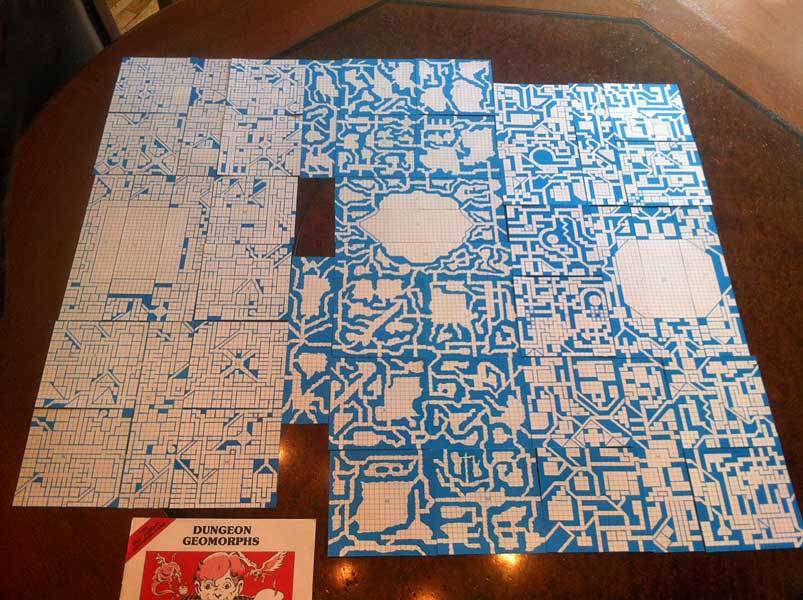
Whilst thinking about Geomorphs I was reminded that Dyson mentioned that his style was reminiscent of Chaosium's hand drawn maps in early Runequest modules. 
...why make the maps pretty?
Because it adds to the GM immersion into the game. Gaming is about roleplaying, and anything that gets you further into the mood and setting is a major boon. So old-school styled maps like the ones I draw remind me of the old Chaosium products that I loved when I was a young one in the hobby - and thus they get me in the mood for that style of game again, thus helping me run such a game.
Now I haven't seen much of the old Chaosium products so I can't comment on their maps, but for me, hand drawn maps remind me of adventures in fanzines, such as this one featuring cross-hatching from Demons Drawl #9 Dec 1984:

Lawrence Beckett has done a very nice drawing of the abbey with matching floorplans. Seeing this again triggered a memory of the old Pelinore maps from Imagine Magazine - these by "Kh" from August 84 look like the inspiration for Lawrence:

Side elevations, floorplans, and cross hatching. I particularly appreciate the locations named on the map in lieu of a key.

For evocative hand drawn dungeons I was always drawn to the dungeon levels in City State of the Invincible Overlord. I liked the odd shapes and the odd noises - laughter, moaning, growling...

My own early efforts at the time were sadly a little lacking... but this effort from 1983 (when I was 11) is interesting to me as it's a one-and-a-half-page dungeon (the other half page is on the back):
Don't ask me why I used pink paper! Notice the key fact - there is no key. My earlier efforts had a keyed map, by this time I'd already realised it was better to put the details on the map. In fact many of my old TSR modules have pencil marks on the maps where I'd written directly on the map what was in each rooms.

I see many attempts by people to produce "professional" looking maps using computers, and I look at these hand drawn maps, and I prefer them in every way. It's not just nostalgia - they're evocative, unbounded and free. When you draw free hand you are limited only by your imagination – notes, illustrations, side-elevations, isomorphic, multi-levelled. Anything that occurs to you can be added.

As an aside, my Geomorph investigations also stumbled across "Pythagorean Tiling" which can be used to tessellate 10x10 Geomorphs and 15x15 Geomorphs into a pattern which obscures the joins between tiles by staggering them:

This looks quite appealing, and stops your dungeon from being rectangular. I'm still considering the pros and cons of having edge pieces (which this pattern makes more difficult) or removing any passages which go off the map.

Sunday, 5 July 2015

Geomorphs: Resurrecting an old idea

I first encountered Geomorphs with the 1978 boardgame “The Sorcerer’s Cave”. I can’t recall that much about the game itself, but the vision of a cave system formed randomly be the placement of tiles always intrigued me – though the realisation of them in this game is very simplistic.

I don’t think I saw anything about Geomorphs again until resurgence of interest about them in the last few years on the internet.

In 2013 the PCs in my D&D game needed to destroy an artefact, so set off in search of “The Juggernaut of the Eternal Labyrinth”. I'm not about to design an infinite labyrinth, and pure mazes are very boring, and my experience of random dungeon generation has been that they’re not that good, so I settled on a Geomorph solution. Simple Geomorphs with a single exit on each side provided a suitable “labyrinth” feel. I made nine Geomorphs and laid them out randomly on the printer/scanner, printed them out, trimmed to size to form a larger Geomorph and repeated:


Combined with a random encounter table, and suitable appearance of the Juggernaut it worked very nicely.

Gary Gygax appears to have invented Geomorphs in 1976, but the concept didn't appear to take off. I'm not sure when Geomorphs resurfaced - there is a 1998 TSR product TSR9556 “Dungeon Builder's Guidebook” with 78 Geomorphs but they seem to have lost the plot completely and don't even seem to fit together. In 2004 Goodman Games released “Dungeon Crawl Classics #9: Dungeon Geomorphs” which are proper Geomorphs, quite large (14 x 19) with 2 connectors on each side.

In 2009 Dyson started his own Geomorph challenge using 10 x 10 Geomorphs with 2 exits on each side. I'm not sure if he originated this format, but this became the de facto standard. Because they're square they can be rotated, and reusing this standard enables Geomorphs from different authors to be used interchangeably.

When my son started DMing OD&D this year he was intrigued by the Gygax originals, and I was surprised to find that they were quite different to the modern concept. 

Like todays standard, the originals are square so can be used "in any position (not necessarily "right-side up")", but they are larger (21 x 21) and have three connector points on each side, but one of them is typically missing. This means that there is always one connection between Geomorphs, but in a varied position.

I got to wondering about resurrecting this concept, then realised that a 15 x 15 Geomorph with 3 connectors on each side could work. If you lay out 4 of these as a square, they would match a 3 x 3 square of  the standard variety, hence would be compatible. With the larger size, you could place chambers or other features off centre. Furthermore, in a larger size there is space for dead ends to lead to features.

So the template would be 15 x 15 square, with 3 connectors at the 3, 8, and 13 columns and rows. To start you off, roll d4 for each side to see if the dead end is left / centre / right / no dead end. If you get a dead end in two adjacent corners, you join them together. When you go down a connector, 3/4 of the time it will go through, 1/4 of the time it will be a dead end.

So the plan would be to mix and match the two types of Geomorph, say put in a vertical or horizontal strip or an embedded section of the other sort. This would break up the repeated pattern of the connectors.

As a proof of concept I've done 12 quick 1" square Geomorphs with a felt tip pen, scanned and inverted them, and then plugged them into a bit of javascript to lay them out randomly. If this page gives you a "secure content warning" that's it complaining about the javascript. Reloading the page will give you a different version of the random Geomorph dungeon below.

I like them - the dead ends seem to work OK, and the repeated pattern is obscured - so I think I'll do some proper ones. One thing I've learned is - if it took that long to create sketch Geomorphs, I think it'll take a bit of time to create 12 proper ones!

Saturday, 28 March 2015

Mapping During Play

A perennial problem is how to map for players. I've tried out various methods over the years: describing the dungeon whilst a player tries to draw the convoluted description and everyone else sits round looking bored...

"The door opens into a room which is 40' by 60'. You enter halfway along the west wall. There is an door in the north wall, about 10' from the eastern end, and a corridor in the middle of the south wall. Oh, and there's 5 orcs in there."

I've tried cutting out map sections which get handed out and stuck together...

"You enter a room which looks like this... hang on... it's here somewhere...oops no, not that one - that's room 7. Ah, it's fallen out."

I've tried filling notepads with map sections which I then hand to players to copy out...

"Right, that's rooms 1-15 drawn. I never knew that two hours could go so quickly. Now all I need to do is draw all the corridor sections. I don't have time to do the eastern half, so they'd better not find the eastern entrance." 

I've tried the "character's wouldn't have the skills or time or instruments to map" method - that was a quick way to suck the fun out of a session!

How about drawing the map on a computer and revealing it to the players one room at a time - technology can solve every problem... until the players go off piste and you have to improvise an encounter.

So in the end I decided I wanted:
  • the physical process of mapping should not detract from the game
  • should not have to spend hours of my life prepping sessions
  • be able to improvise new maps on the fly
  • have the same system for dungeons, towns, and wilderness
  • have the same system for purchased modules and home-grown adventures
  • have the same system for floor plans, side-elevation maps, and isometric maps
And finally, but far from the least important
  • If the map is cool then the player's map should be cool
One day I bought some thin paper you could overlay over a map and trace through it. As we adventured I would pick up their map, put it over mine, draw on whatever extra was needed whilst describing what they saw and put it back down. One minor but important detail is that I keep the paper the same way up as my map, that is for them the map is the other way up, else I find it really confusing!

I have never looked back!

Here are some examples from our Star Frontiers campaign.

First a spacestation map, and the player's traced map:

DM's Map
Partial Tracing for Players
Here is an isometric map of a compound: